
SPACE · TIME · SOUND
The First
Billion Years
A journey from darkness into light.
Ten scenes. One unfolding universe.
Scroll to explore. Scroll back to reverse.
Scroll-controlled visuals · silent while scrolling.
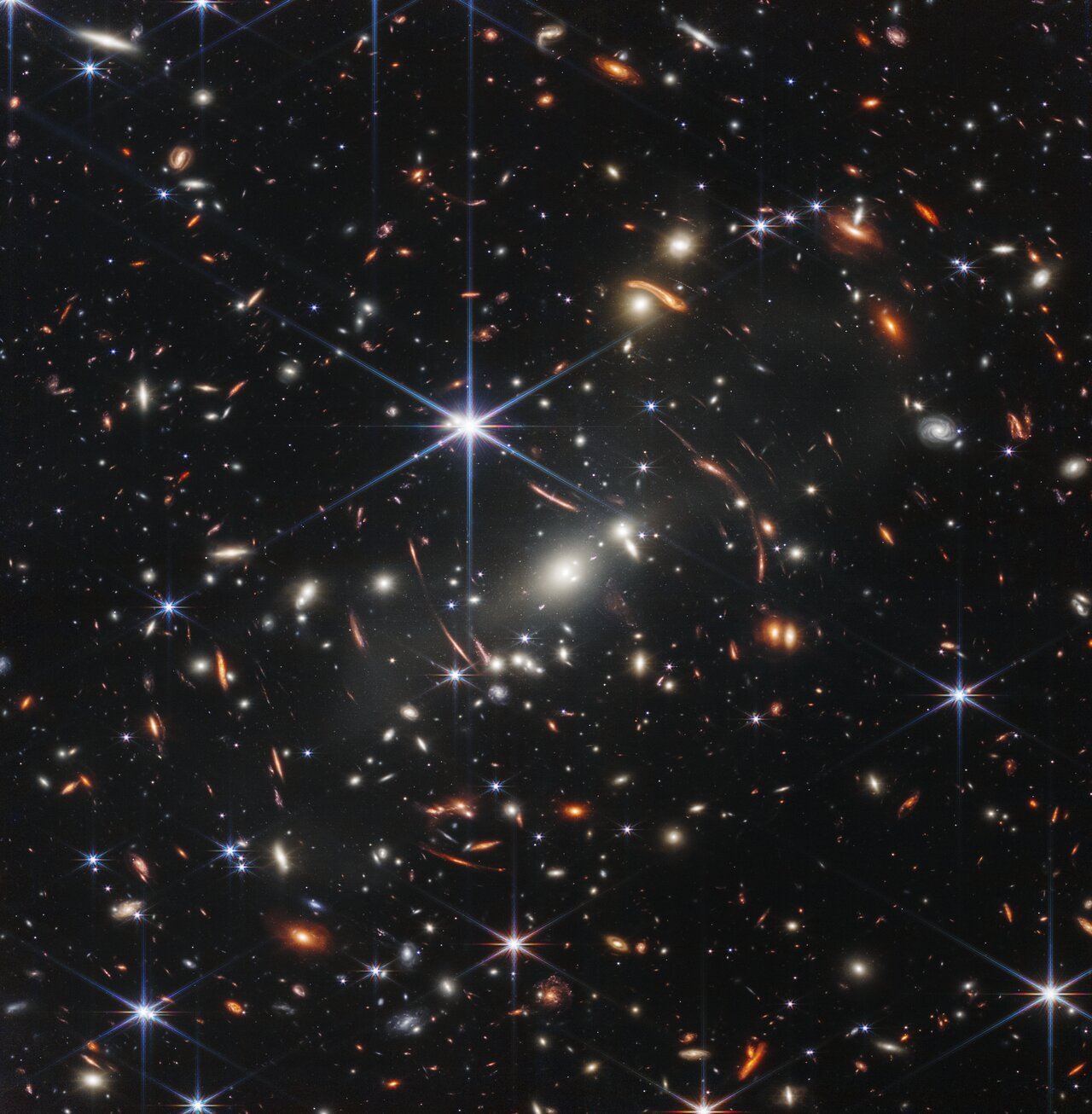
Webb’s First Deep Field — SMACS 0723 · NASA, ESA, CSA, and STScI. CC BY 4.0. Infrared composite; cropped and darkened.
SCENE 01 / The Cosmic Calendar
The Cosmic Calendar
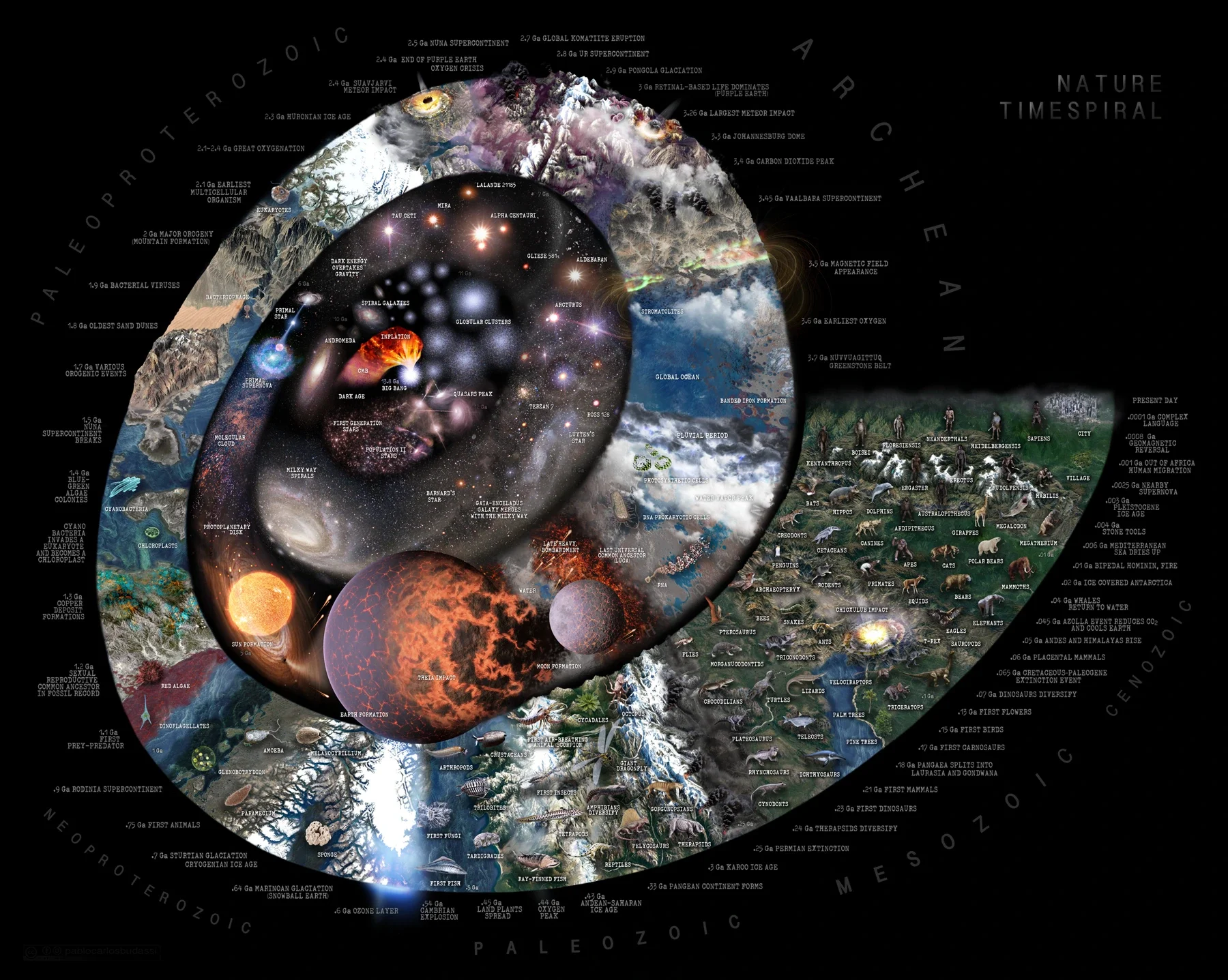
Raise your arm to the sky. Imagine the span of all time beginning from your heart, running up to today at the top of your fingertips. The big bang emanates from your core, the first stars are born at your shoulder, and the Milky Way galaxy at your bicep. Along your elbow to well past your forearm, life consists of nothing but bacteria. Many celled life begins at your wrist, the dinosaurs originate in the middle of your palm, and go extinct around your last finger joint. The whole of humanity spans only your finger nail, and all of recorded history is blown away in the dust of one stroke of a nail file.
Nature Timespiral · Pablo Carlos Budassi, via Wikimedia Commons. CC BY-SA 4.0. Resized and converted; full diagram retained. The derivative retains the same license.
SCENE 02 / The Dark Age
The Dark Age
After its birth in a blaze of light
Our universe sank into darkness.
A time of no stars, no galaxies and no planets for life to make a home.
These are the cosmic dark ages of the first billion years.
Slowly, tendrils begin to form - a dance of dark matter - still pulsing with the energy from rapid expansion. As our journey unfolds, listen for the dark matter theme on the french horn, accompanied by fluctuations played by cosmic orchestra, evolving from long tones into playful melodies and ultimately - due to the stretching of space itself - into pulsing rhythms.
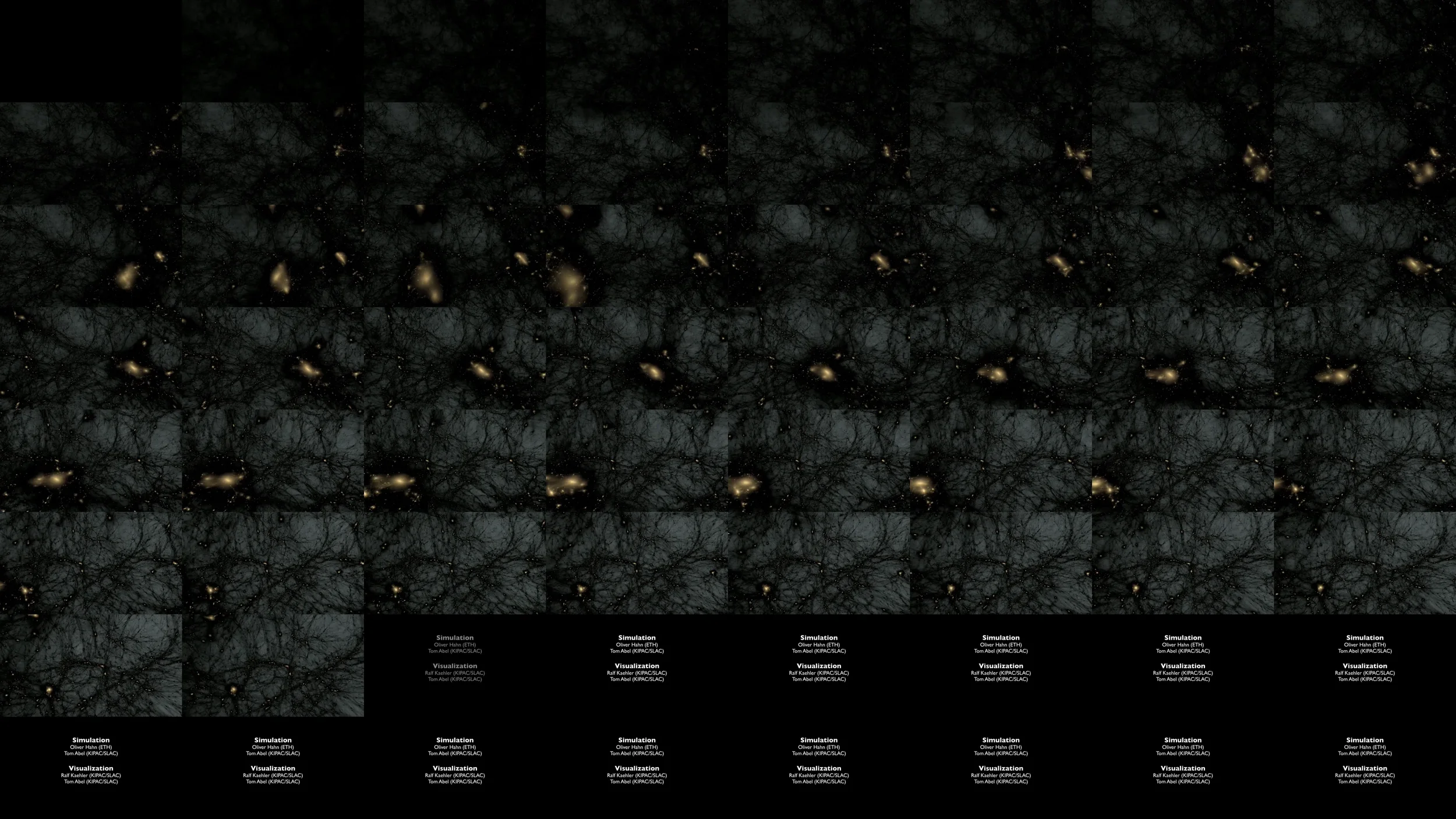
Dark Universe · video file supplied by David Ibbett. Original frame retained; compressed and resampled for reversible scroll control. Scientific visualization, not a telescope observation. Simulation: Oliver Hahn (ETH), Tom Abel (KIPAC/SLAC). Visualization: Ralf Kaehler and Tom Abel (KIPAC/SLAC). Original closing credits retained.
SCENE 03 / The First Star
The First Star
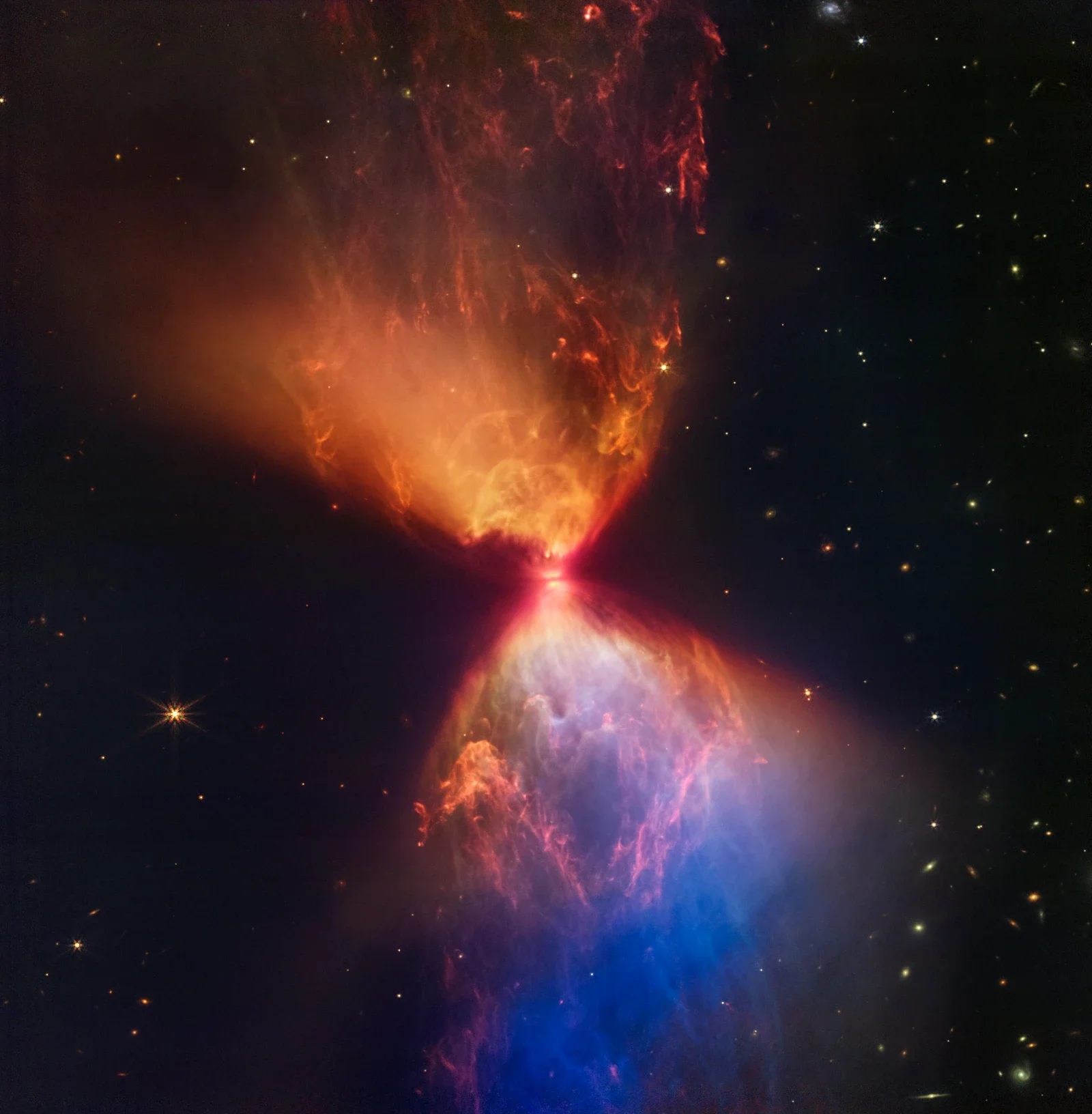
After its violent birth the first star shines, more massive than any in our universe today, burning with a clean flame of pure hydrogen. This colour can be translated into just a few delicate chimes by our cosmic orchestra.
But how long can such a massive furnace sustain its radiance?
L1527 and Protostar (NIRCam Image) · NASA, ESA, CSA, STScI; Image Processing: Joseph DePasquale (STScI), Alyssa Pagan (STScI), Anton Koekemoer (STScI). NASA media usage terms. Nearby protostar used as a visual analogue; not an image of a primordial star. Resized and scaled for presentation.
SCENE 04 / Supernova
Supernova
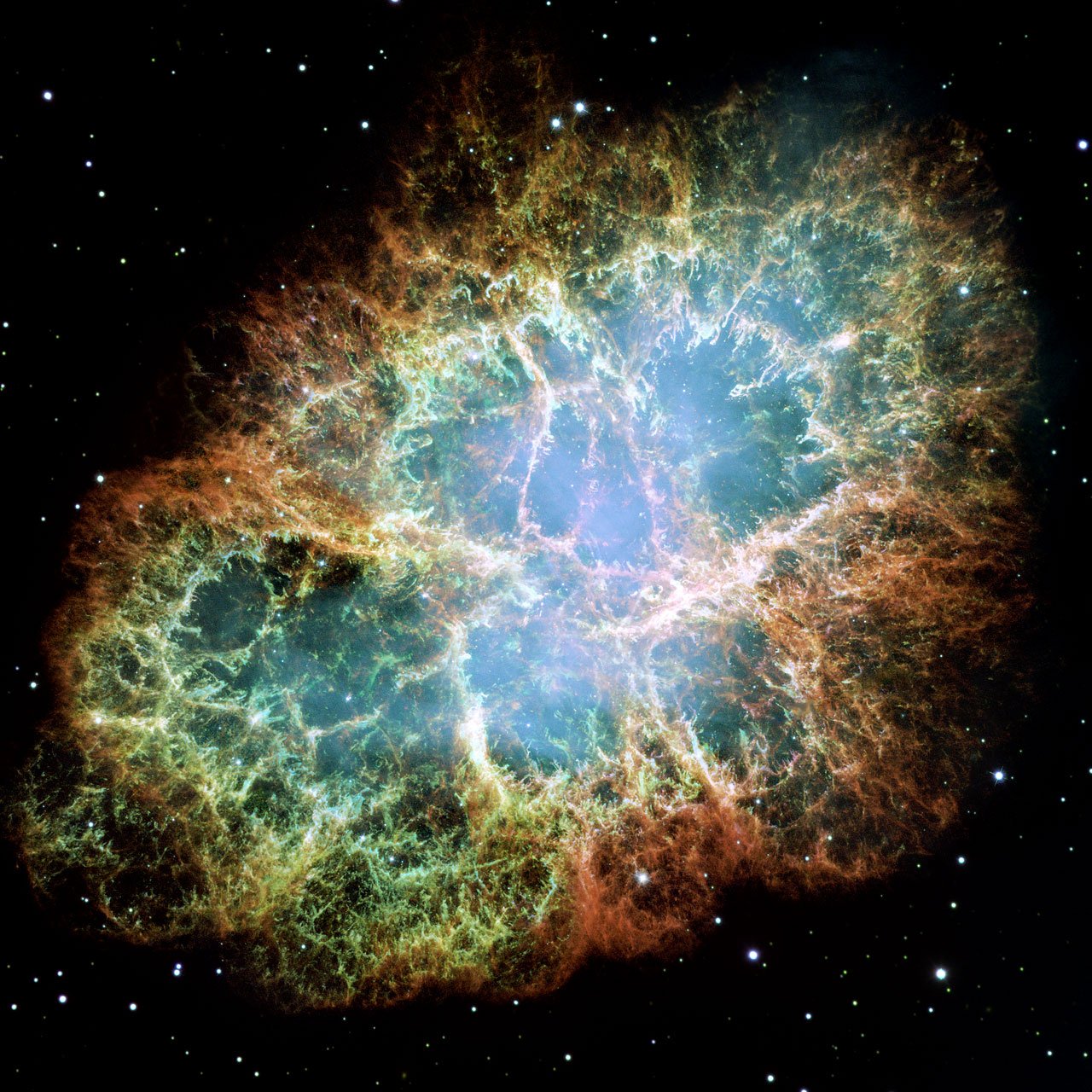
Crab Nebula · NASA, ESA and Allison Loll/Jeff Hester (Arizona State University). Acknowledgement: Davide De Martin (ESA/Hubble) CC BY 4.0. Nearby supernova remnant; visual analogue, not a first-generation supernova.
SCENE 05 / Starburst
Starburst
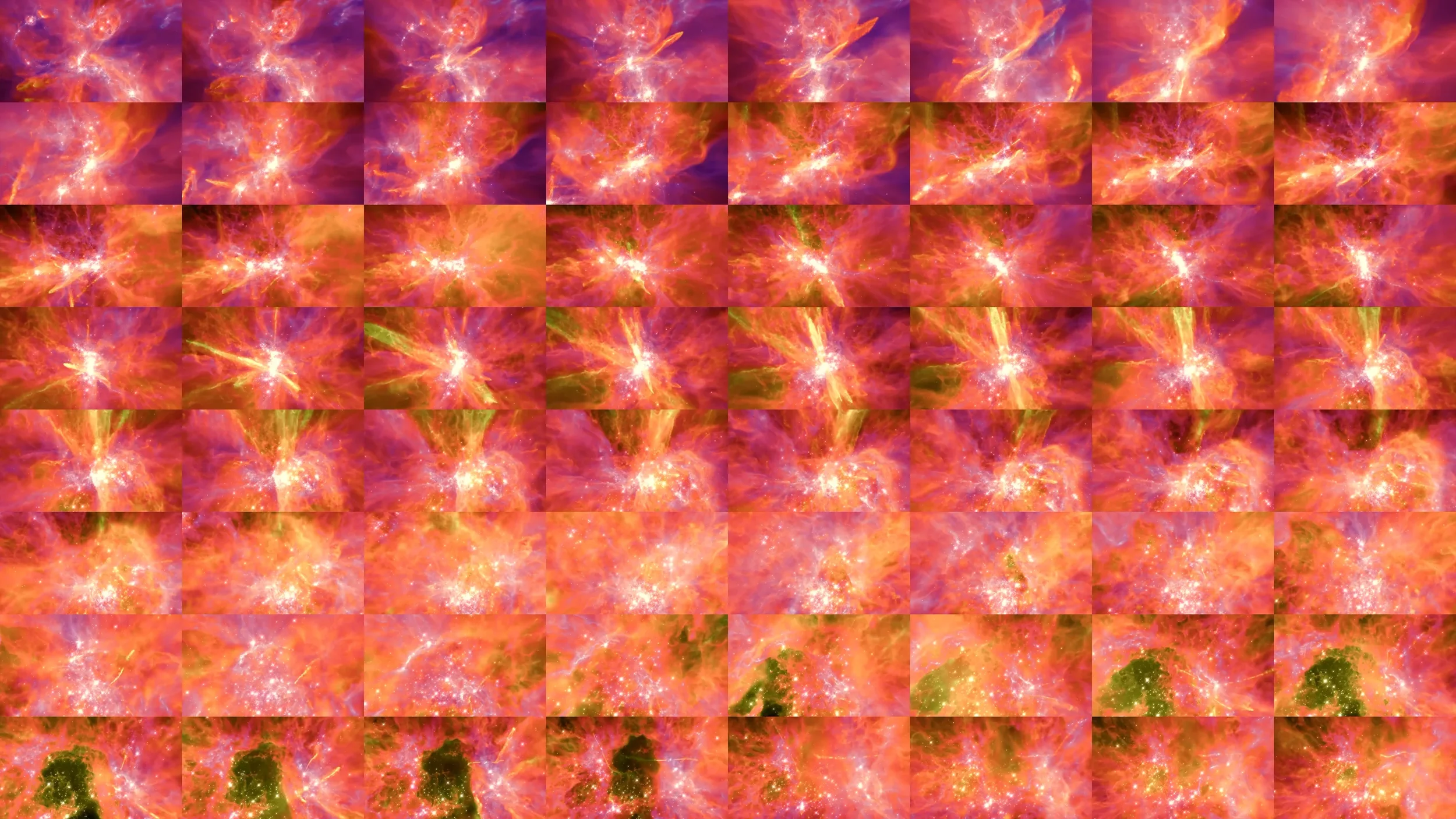
The first stars shone brighter, lived shorter and died more spectacularly than any in our universe today. Their legacy? Heavier elements, drifting into space: silicon, sulfur, argon, soon followed by aluminum and titanium. Each element adds its own chime to the unfolding cosmic symphony in a cycle of death and rebirth.
The Anvil of Creation · Dávid Guszejnov, Mike Grudić, and the STARFORGE Project. CC BY 4.0. Simulation of a star-forming molecular cloud; an analogue, not a simulation of primordial stars. Resampled for scroll; reading-mode video compressed and accelerated fourfold. Highlight: source 01:30–02:30, shown in 15 seconds.
SCENE 06 / Reionization Begins
Reionization Begins
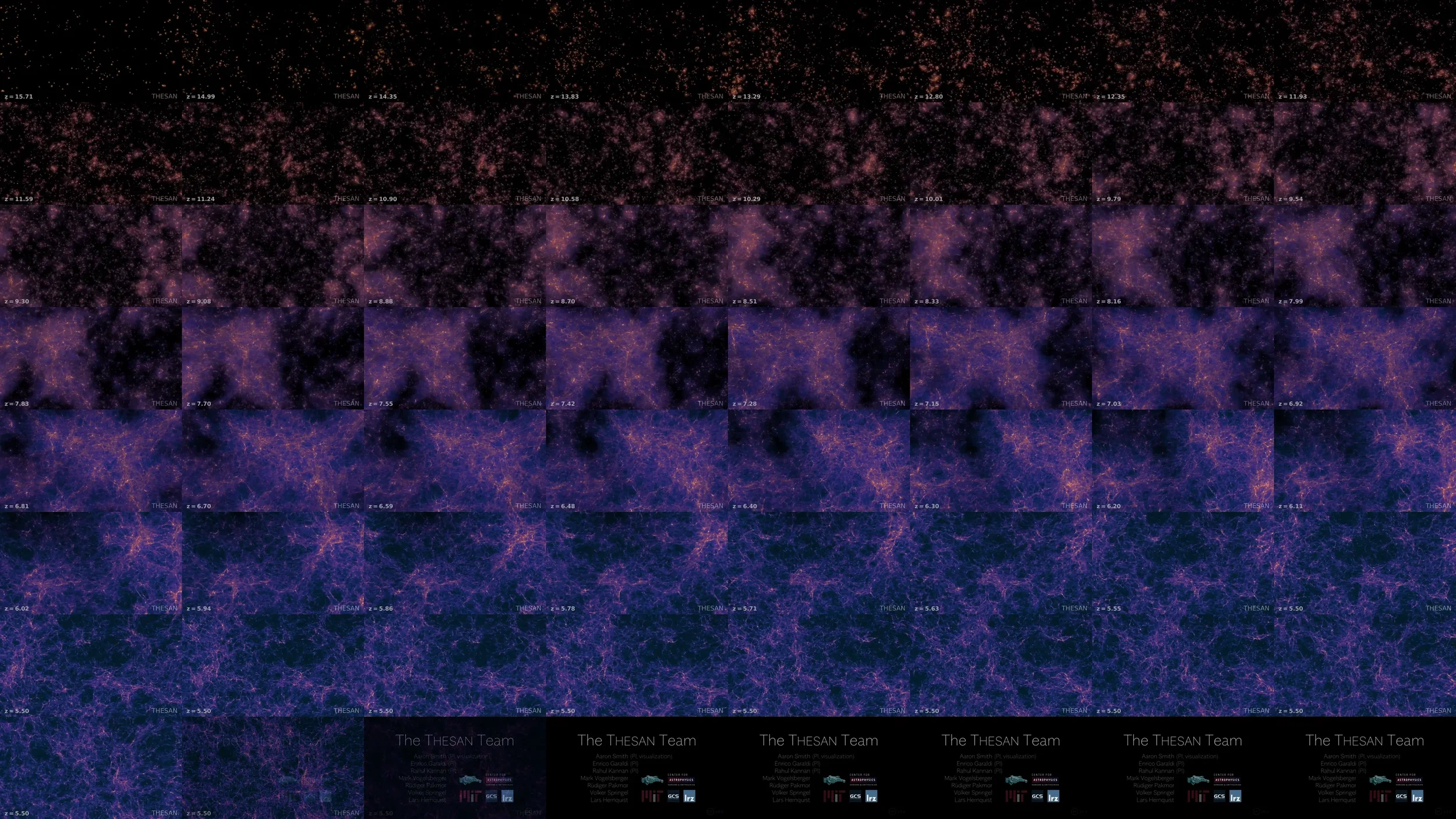
Starlight rebounds across the universe, echoing from cloud to cloud until finally absorbed. All the while, our cosmic fluctuations continue to resonate, slow and stretch - sculpting the universe on larger and larger scales.
At this time, the universe is a dense fog of gas. Gradually, through a process called reionization, the growing starlight extends to bubbles of charge - pooling like dew drops in the morning before evaporating to the void. Listen closely for rising patterns of threes climbing higher and higher as our orchestra translates this spreading light into sound.
THESAN Simulations · “3D internal evolution of gas and radiation”. CC BY 4.0. Scientific simulation, not a telescope observation. Resampled and crossfaded for scroll control; colours retained.
SCENE 07 / Black Holes
Black Holes
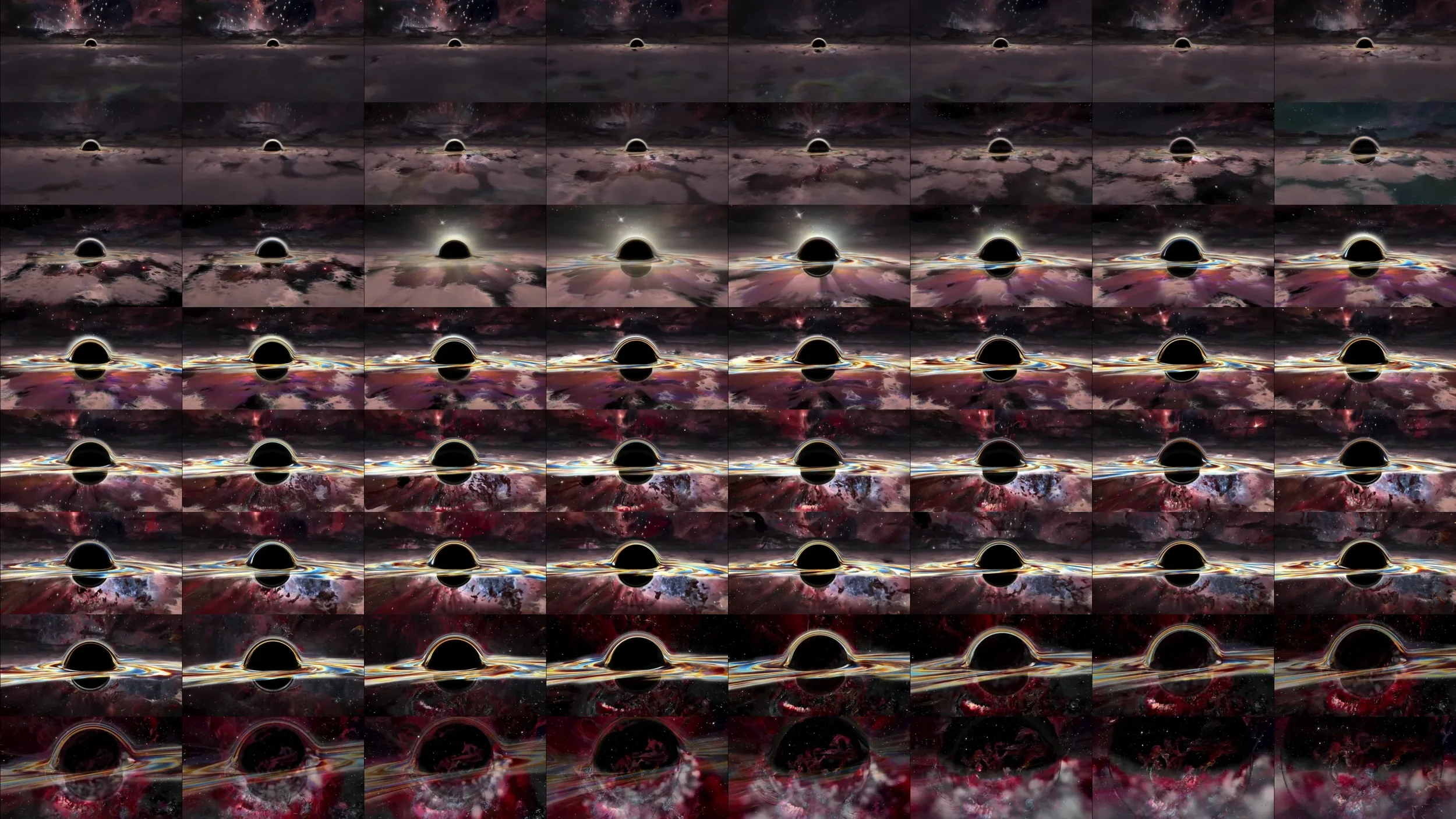
Earlier than we could have imagined the first black holes form - structures so dense that not even light can escape, some growing to more than a billion suns. Once born, black holes gravitate together with nearby star clusters to form galaxies - the ancestors of our Milky Way - blazing with a light brighter than the stars. The trombones and tuba translate the shape of such a galaxy - GN Z11 - into a jagged melody.
Black Hole MOS · footage supplied by David Ibbett. Original in-frame credits retained. Resized and resampled for scroll control. Visualization; not an observation of GN-z11.
SCENE 08 / Dance of the Merging Galaxies
Dance of the Merging Galaxies
At 300 million years, we see the first galaxies containing carbon and oxygen - the building blocks of life. As the universe expands, our cosmic fluctuations cool and stretch to become deep tones: a rhythm which decides the distances between galaxies.
New mysteries unfold - galaxies of smooth elliptical shape filled with young stars, played by the cellos. Looking closely, we can see the first subtle signs of motion within their cores.
Complexity increases with the rise of the first galactic disks with rotating plains of motion, birthing new stars as their clouds collide, their shapes translated into music by the winds.
Monster elliptical galaxies - larger than we ever thought possible - arrive on the cosmic stage, formed from galactic collisions on a colossal scale they engage in a dance of destruction and new creation played by the entire string section.
Small galaxies are swallowed up by their larger cousins - merger after galactic merger roiling the cosmic soup to produce larger and more complex forms.
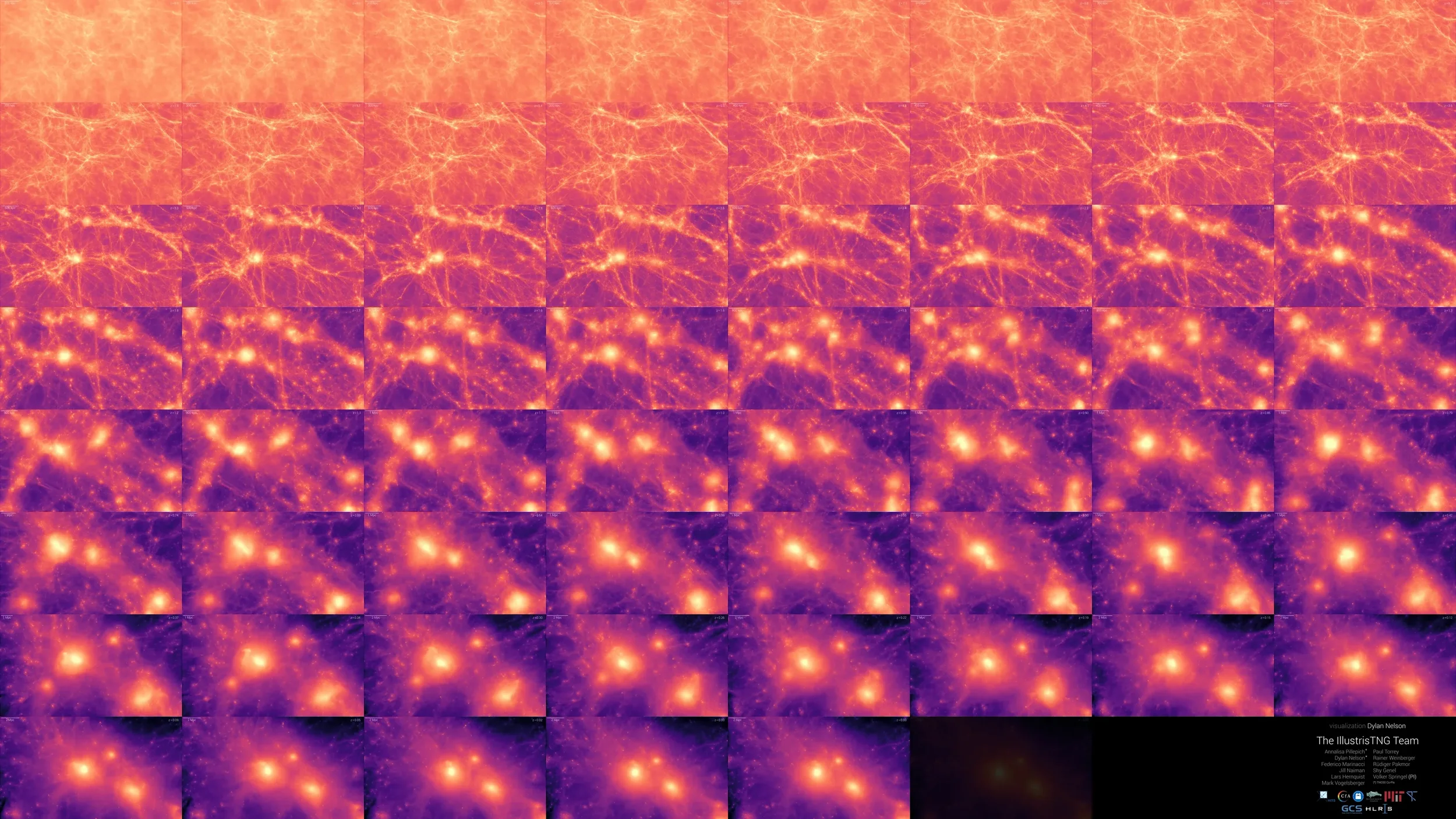
Formation of a Galaxy Supercluster · Dylan Nelson / TNG Simulations. TNG300 simulation spanning 500 million years after the Big Bang to the present day; not confined to the first billion years. Resized and resampled for scroll.
SCENE 09 / Colossal Merger
Colossal Merger
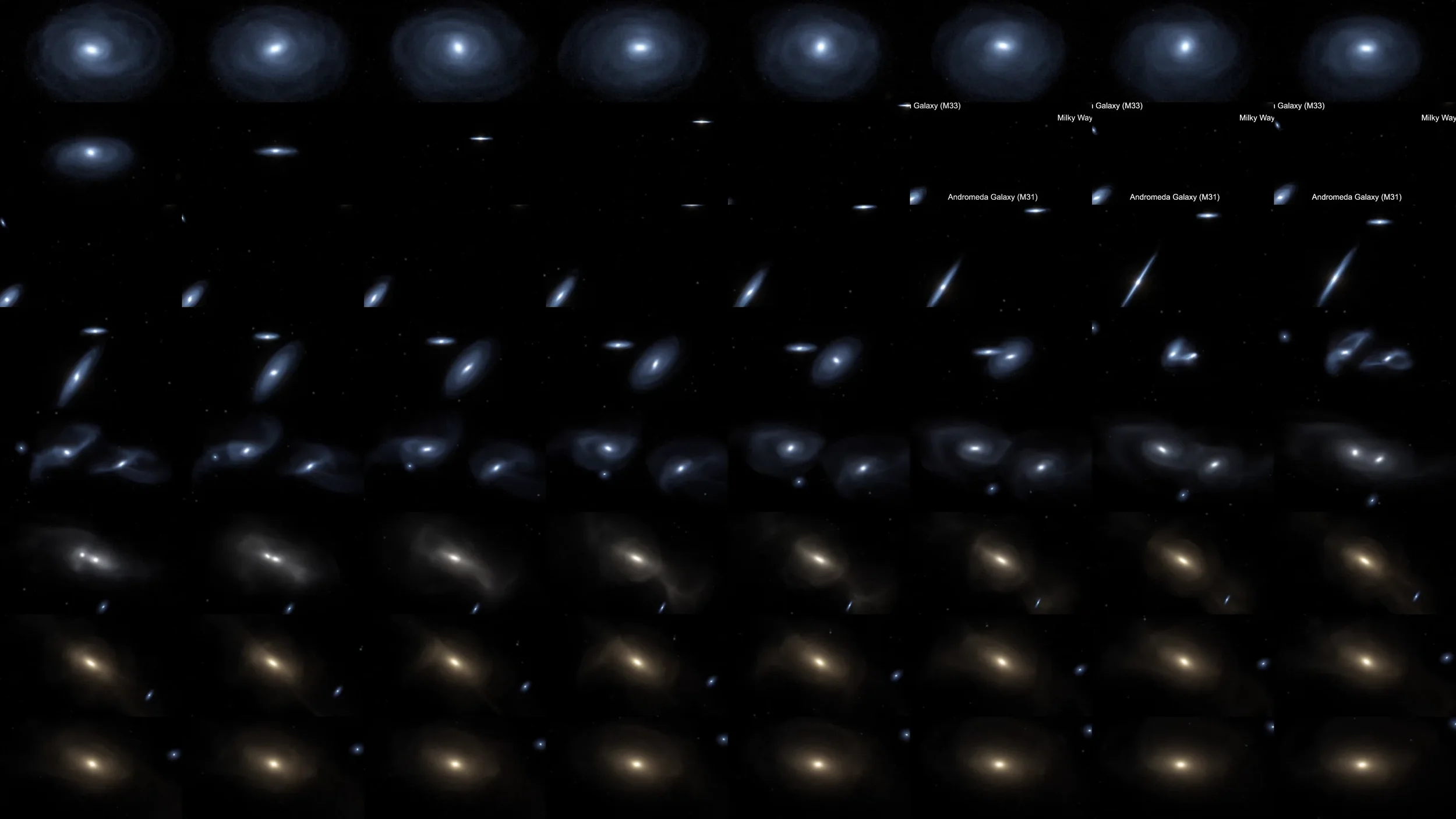
Crash of the Titans: Milky Way & Andromeda Collision · Frank Summers (STScI), Gurtina Besla (Columbia University), and Roeland van der Marel (STScI). Historical model of a possible future Milky Way–Andromeda collision, used as a merger analogue. Not an early-universe event or a guaranteed prediction. Resized and resampled for scroll. Enlarged 1.5× with a centred crop; original edge labels are outside the crop.
SCENE 10 / Universe Fills with Light
Universe Fills with Light
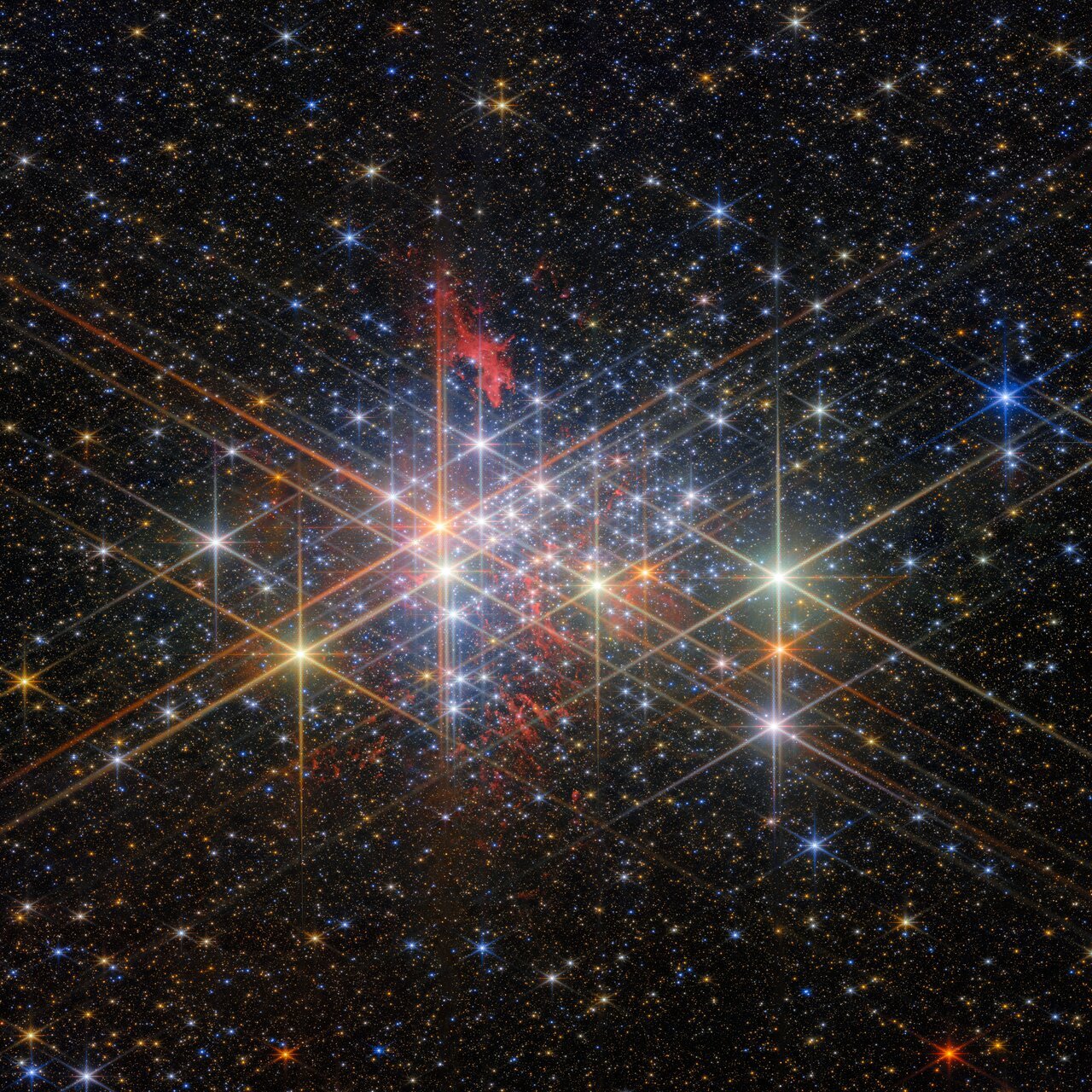
The epoch of reionization is upon us - and with it the end of the dark ages and coming of the cosmic dawn. For the first time, light is free to travel through the universe, and reach us here, on earth.
Raise your arm to the sky. Imagine the span of all time beginning from your heart, running up to today at the top of your fingertips. Though our part in this story is short, we have discovered so much about the universe - uncovering connections between light, matter, the stars, the planets and life on earth. Take a breath to appreciate this connected moment with gratitude, and our marvelous place at the heart of a universe filled with light.
Westerlund 1 (wide-field view) · ESA/Webb, NASA & CSA, M. Zamani (ESA/Webb), M. G. Guarcello (INAF-OAPA) and the EWOCS team. CC BY 4.0. Nearby Milky Way star cluster used as a visual analogue, not a view of reionization. Cropped and darkened.
Scientific context & editorial notes
These editorial notes are separate from the supplied narration. The scene order is a musical narrative, not a calibrated clock. The on-page progress bar measures reading progress, not elapsed cosmic time.
Scenes 1 and 10: the arm calendar. This is a poetic scale model spanning all cosmic history, beyond the first billion years. Its anatomical placements depend on chosen proportions. “Nothing but bacteria” is an oversimplification of early life; obtain a biology review before educational publication. - Scenes 2 and 10: dark ages, cosmic dawn and reionization. Distinguish the era before the first stars, the onset of starlight, and the extended ionization process. They are not a single event at one billion years. Reionization strips electrons from neutral gas; the gas does not evaporate away. Transparency depends on wavelength: light already travelled freely after recombination, long before reionization. See NASA: Early Universe. - Scenes 3 and 5: first stars. Primordial stars formed from hydrogen and helium, with traces of other light elements, not pure hydrogen. Their mass distribution and outcomes remain uncertain; “more massive than any” and universal spectacular explosions are stronger claims than the evidence supports. Element production is not a universal sequence matching the order of the musical chimes. See NASA: What Were the First Stars Like?. - Scenes 2, 6 and 8: fluctuations and music. Musical pitch, rhythm and instrumental mappings are artistic sonifications. The acoustic imprint is statistical, not a rule fixing every galaxy-to-galaxy distance. Distinguish early plasma sound waves from later gravitational growth and dark-matter filaments. See NASA: Baryon Acoustic Oscillations. - Scene 7: black holes. Do not equate GN-z11 with a billion-solar-mass black hole. NASA's account of the 2024 result describes an inferred mass of about two million Suns at a cosmic age of roughly 430 million years. Bright emission comes from accreting material. The simple sequence “black holes plus star clusters make galaxies” needs qualification as a galaxy-assembly model. See NASA: GN-z11. - Scene 8: galaxy chronology. Before publication, ask the science team for specific observational citations for carbon and oxygen at 300 million years, the earliest rotating disks and the proposed elliptical-galaxy sequence. This demo does not present those milestones as independently verified dates. “Rotating plains” is retained verbatim; “planes” may be intended.
Visual interpretation
The opening uses Webb’s SMACS 0723 deep field. Scene 1 uses the supplied Cosmic Calendar diagram (Efbrazil and the extended version on Wikimedia Commons), not the anatomical arm-calendar illustration. Scene 3 uses the nearby L1527 protostar as a visual analogue; its scroll-driven enlargement is a presentation effect, not a physical evolutionary model. Scene 4 retains the Crab Nebula analogue.
Scene 5 uses STARFORGE’s “The Anvil of Creation,” a molecular-cloud star-formation simulation, not a simulation of the first metal-free stars. Scene 6 uses THESAN’s gas and ionizing-radiation evolution, a scientific reionization simulation. Scene 7 uses the supplied Black Hole MOS visualization; it is not an observation of GN-z11.
Scene 8 uses Dylan Nelson’s “Formation of a Galaxy Supercluster” from TNG300, the film linked on Vimeo. Its source chronology runs from 500 million years after the Big Bang to the present day, well beyond this project’s titular period. Scene 9 uses NASA’s “Crash of the Titans,” a historical simulation of a possible future Milky Way–Andromeda encounter. It is a merger analogue, not a primordial collision. A later study changed the confidence in that future encounter; it should not be presented as inevitable. See NASA’s 2025 update.
Scene 10 uses the nearby Westerlund 1 cluster as a poetic image of a universe filled with light, not a photograph of the epoch of reionization. Colours in astronomical images and simulations are representational.
The local preview samples each film into 64 frames and blends adjacent samples during scrolling. This preserves the full frame and full time range, but does not reproduce every original video frame. Reading mode offers the compressed video. STARFORGE’s reading-mode copy is accelerated fourfold; its scroll time is controlled entirely by the reader. Original source links and changes are recorded in image-credits.json and video-credits.json.
Text decision
Scenes 4 and 9 have titles but no narration, following the current request. The earlier chat included a sentence under Scene 9; it is saved in source-note.txt and deliberately omitted from the page. Canva was used only as visual reference; none of its narrative or image files were imported. The subsequently supplied Black Hole MOS clip includes audio; it is retained only in the user-started reading-mode video. Scroll mode remains silent.
## Updated presentation choices
Nature Timespiral by Pablo Carlos Budassi replaces the year-based calendar diagram. It presents cosmic and biological history on a spiral; the final 500 million years use a different angular scale. The supplied arm-length narration remains unchanged.
The Dark Age selection is the user-supplied Dark Universe film. It is a visualization rather than a direct observation; its entire timeline should not be interpreted as confined to the cosmic dark ages. The previous APOD Podcast selection has been replaced.
Starburst uses source 01:30–02:30 at four times playback speed (15 seconds). Colossal Merger is cropped to enlarge the galaxies 1.5×; edge time labels are omitted by that crop. These are presentation edits, not changes to the underlying simulation.